

The digital asset world is changing fast. Groundbreaking projects are combining artificial intelligence with cryptocurrency mining. Hash AI Crypto is leading the way in this exciting field.
Hash AI Crypto uses machine learning to change how mining works. It wants to make mining more efficient. It also aims to reduce the environmental impact and solve problems like hardware waste.
This project is seen as a real solution, not just a gamble. Its design and Hash AI tokenomics are key to its success. They make sure everyone works towards a sustainable future.
This is just the start of exploring how smart systems can change the blockchain’s future.
1. Defining Hash AI: The Convergence of AI and Cryptocurrency Mining
Hash AI changes mining by making AI a key part of it. It combines blockchain’s security with AI’s smart power. This creates a new kind of digital asset that’s smarter and more efficient.
“AI-powered mining” means two main things. First, AI helps manage mining gear, saving energy and time. Second, it uses mining power to train AI models.
Hash AI’s design uses both ideas. It’s not just AI helping mining. It’s a system where mining and AI work together. This makes it different from other projects.
1.1 The Core Proposition and Value Driver
Hash AI offers three main benefits: better efficiency, more profit, and easier access. It uses AI to solve puzzles faster and use less energy. This solves old problems.
For users, it means easier mining. The platform does the hard AI work. You can just stake tokens for rewards, no special gear needed. This is a new way for investors.
The goal is a sustainable mining system. It’s cheaper and better for the planet. Selling AI power to others also brings in more money. This money helps the system grow and improve.
1.2 The Development Team and Founding Vision
The team behind Hash AI is full of experts. They know blockchain and AI well. This is key for success in this area.
They bring important skills:
- Blockchain Proficiency: They make sure the system is secure and works well.
- AI/ML Specialisation: They use the latest AI for better predictions and optimisation.
- Operational Experience: They know how to run big networks, making the platform practical.
The team wants to change crypto mining. They aim to make it more efficient and useful. Their focus is on real value, not just speculation.
2. The Inefficiencies of Traditional Mining Hash AI Addresses
Cryptocurrency mining uses a lot of power, leading to big problems like harming the environment and centralising power. These issues make it hard for the industry to be sustainable and for everyone to participate. This is why new, energy efficient crypto solutions are needed.
After halving events, where rewards are cut in half, miners face even more challenges. They struggle to make money because mining costs are linked too closely to market prices. This makes the whole system very unstable.
2.1 Prohibitive Energy Consumption and Environmental Impact
Traditional mining is a race to solve the most calculations first. This race uses a lot of energy. Bitcoin alone uses as much electricity as many countries, causing environmental worries.
The environmental damage goes beyond just energy use. Most of this energy comes from non-renewable sources, adding to carbon emissions. This makes it hard for crypto to be seen as sustainable. Finding energy efficient crypto options is now a must for the industry.
2.2 Barriers to Entry and Centralising Pressures
Traditional mining is also very expensive and technical. Starting a mining operation needs a lot of money for special hardware, cheap electricity, and technical skills. This makes it hard for individuals to join.
This leads to mining power being held by big operations and pools. This goes against the idea of crypto being decentralised. The data shows that after halving, it’s hard for small miners to keep up, making centralisation worse. This shows we need ways to make decentralised mining real.
| Inefficiency Factor | Impact on Traditional Mining | The Need for Innovation |
|---|---|---|
| Energy Intensity | Exorbitant electricity consumption leading to high operational costs and environmental damage. | Shift toward energy efficient crypto protocols that maintain security without wasteful computation. |
| Capital Requirements | Prohibitive costs for hardware and infrastructure, excluding retail participants. | Models that lower entry barriers through tokenisation or shared resources, promoting decentralised mining. |
| Economic Vulnerability | Profitability tightly pegged to volatile coin prices and diminishing block rewards post-halving. | Systems with more diversified reward mechanisms and reduced reliance on pure hardware expenditure. |
| Technical Complexity | Requires specialised knowledge to set up, optimise, and maintain mining rigs effectively. | Simplified, user-centric platforms that abstract away technical complexity for broader adoption. |
The problems of energy waste and centralised control show we need to change how mining works. We need new tech to use resources better and let more people join. This is where artificial intelligence can help us find a new way forward.
3. The Artificial Intelligence Engine at the Core of Hash AI
Hash AI’s power comes from its advanced artificial intelligence system. This brain-like engine constantly checks data and makes quick decisions to improve mining. It aims to keep improving itself, making more money while using less energy and avoiding problems.
3.1 Adaptive Algorithm Optimisation for Mining
Hash AI uses smart algorithms that change as needed. These algorithms adjust mining settings based on the network’s current state. The goal is to get the highest hash rate with the least effort and energy.
This AI algorithm optimisation tweaks things like thread concurrency and memory speeds. It makes tiny changes every second to get the best performance. This is different from old ways, where settings were set and left the same for a long time.
The table below shows how Hash AI’s approach is smarter than the old ways:
| Mining Parameter | Traditional Static Approach | Hash AI Adaptive Optimisation |
|---|---|---|
| Hash Rate Configuration | Manually set, rarely updated | Continuously tuned for maximum output |
| Power Draw Management | Fixed power limit, often inefficient | Dynamic adjustment based on real-time profitability |
| Hardware Cooling | Reactive; fans run at constant speed | Proactive cooling linked to predictive thermal models |
| Algorithm Selection | Mines a single coin persistently | Can switch algorithms based on predicted profitability |
3.2 Machine Learning Models for Predictive Analytics
The second layer uses machine learning for predictive analytics crypto. These models look at lots of data to guess what will happen next. This helps mining operations plan ahead instead of just reacting.
Machine learning helps with timing, predicting failures, cooling, and power management. Hash AI’s system does all this and more. It looks for patterns to guess when mining will get harder or when electricity will be cheaper.
For example, it can prepare for harder mining by using more resources. It can also schedule big tasks when electricity is cheap. Most importantly, it can predict when hardware might fail, so it can fix it before it stops working.
This forward-looking insight is a big deal. It helps the platform make smart choices to keep profits up and operations stable. The mix of smart optimisation and predictive power makes mining more efficient, resilient, and strategic.
4. Understanding Hash AI Crypto: Tokenomics and Distribution Model
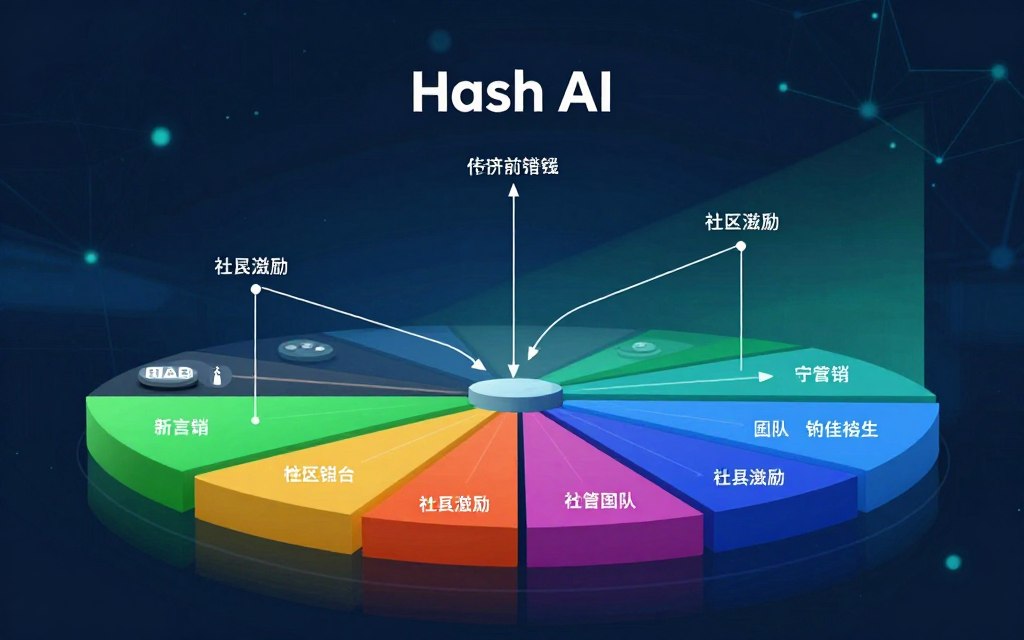
The $HAI token is more than just a digital asset. It powers the Hash AI network and acts as a governance tool. Its tokenomics design ensures sustainability, growth, and fair participation. This framework controls token creation, distribution, and use, affecting long-term value and stability.
4.1 Token Supply Dynamics and Emission Schedule
Hash AI’s token economics is transparent, building trust. The total $HAI token supply is fixed, avoiding inflation that can reduce value over time.
The circulating supply grows slowly, following a set schedule. This aligns with project milestones and rewards for participants. It balances immediate needs with long-term goals.
| Allocation Category | Percentage of Total Supply | Primary Purpose / Notes |
|---|---|---|
| Community Rewards & Mining | 40% | Distributed as staking rewards to fuel the AI mining network and attract participants. |
| Ecosystem & Treasury | 25% | Funds for future development, partnerships, grants, and platform security. |
| Team & Advisors | 15% | Subject to multi-year vesting schedules to ensure long-term commitment. |
| Initial Sale & Liquidity | 20% | Provides initial project funding and ensures deep, stable market liquidity. |
For the latest on circulating supply and other metrics, check a detailed tokenomics breakdown on major platforms.
4.2 Utility: Staking, Governance, and Network Fees
The real value of $HAI lies in its utility. It’s essential to the Hash AI experience. Its uses create demand and offer benefits to holders.
Staking for Mining Rewards: Users stake $HAI to contribute to the mining pool. They earn a share of block rewards, paid in $HAI or other cryptocurrencies. This makes mining accessible without personal hardware.
Governance Rights: $HAI is a crypto governance token. Holders vote on proposals like protocol upgrades and fee changes. This ensures the community shapes the project’s future.
A solid tokenomics model aligns incentives for developers, miners, and investors. It creates a cycle of participation and value creation.
Network Fee Medium: $HAI tokens are needed for advanced features and services in the Hash AI ecosystem. This internal activity supports the token’s value beyond speculation.
These utilities make $HAI more than a passive investment. It’s a key to participation, profit-sharing, and ownership in AI-optimised cryptocurrency mining.
5. Mechanics of the AI-Powered Mining Process
Hash AI’s innovation makes mining easy for users. By staking tokens, users get access to AI-optimised mining. This method removes the usual barriers of mining, making it simpler to earn rewards.
This approach helps make the blockchain more sustainable. It smartly uses computer power.
5.1 Participation Through Token Staking
Joining Hash AI is easy. Users don’t need to buy hardware. Instead, they stake their tokens in a smart contract.
This action gives users a share of the network’s mining power. It’s a win-win, securing the network and rewarding the staker.
Staking has two main benefits:
- No Hardware Ownership: Users don’t need to buy mining rigs or rent data centres.
- Flexible Commitment: Staking terms can be changed, fitting users’ financial plans.
- Immediate Accessibility: Staked tokens start working right away, thanks to AI.
5.2 Transparent Reward Distribution and Yields
Rewards are given out clearly and automatically. The amount earned depends on three things:
- The number of tokens staked.
- How long the tokens are staked.
- The AI’s mining success during that time.
This way, rewards match the network’s success. All transactions are recorded on-chain, proving every reward. This openness builds trust in the platform.
Hash AI’s financial model is different from traditional mining. As one analysis points out:
“The financial contrast between mining Bitcoin and hosting AI workloads is sharp… AI and HPC hosting uses a different model.”
This model is clear when comparing Hash AI to cloud mining. Here’s a table showing the main differences:
| Feature | Traditional Cloud Mining | Hash AI’s AI-Powered Model |
|---|---|---|
| Core Resource | Pre-sold hash rate from static hardware | Dynamic, AI-optimised computational power |
| Profitability Driver | Primarily cryptocurrency price and mining difficulty | AI efficiency, multi-algorithm optimisation, and broader compute demand |
| Cost Structure | Fixed contract fees, often with high margins for the provider | Rewards based on platform performance; no separate hosting fee |
| Adaptability | Low; contracts are rigid and can become unprofitable | High; AI continuously adapts to the most profitable tasks |
The yield depends on the AI’s ability to find the most profitable tasks. This makes the reward system more efficient and resilient. It’s a forward-thinking approach that links rewards to technology, aiming for a sustainable blockchain future.
6. The Broader Hash AI Ecosystem and Platform
Engaging with Hash AI means using a top-notch platform. It’s built on user-focused analytics and top-notch security. This setup makes AI mining real and easy to handle.
6.1 User Dashboard and Performance Analytics
The Hash AI user dashboard is all about clarity and control. It turns complex mining data into easy-to-understand insights. This lets every token holder manage their part well.
Key features on the dashboard include:
- A Complete Staking Overview: See your staked tokens, their value, and where they are in the AI mining pool live.
- Dynamic Yield Estimators: Tools show possible rewards based on network activity and AI model performance. They help you make smart choices.
- Granular Performance Analytics: Get detailed charts and metrics. They show your mining yield trends, AI algorithm efficiency, and network data comparisons.
- Customisable Alert Systems: Set up alerts for big events, like reward distributions or updates on the Hash AI roadmap.
This clear, data-based method makes mining easy to understand. You’re not just getting rewards; you’re watching your digital asset’s performance in a complex financial system.
6.2 Security Protocols and Governance Mechanisms
Keeping the platform safe is a top priority. Hash AI uses a strong strategy to protect assets and guide the network through group decisions.
The project’s focus on AI crypto security starts with its setup. It gets regular audits from top firms. These audits check the code’s strength against attacks. For keeping assets safe, the platform uses non-custodial methods and secure partner solutions for optional services.
Governance is key to the ecosystem’s future. Hash AI token holders can shape the project’s path through an on-chain governance module. This includes:
- Proposal Submission: Community members can suggest and submit proposals for votes.
- Deliberation and Debate: Proposals get discussed in forums, allowing for improvement and analysis.
- On-Chain Voting: Token holders vote, with their staked balance deciding on changes like fee adjustments or major upgrades on the Hash AI roadmap.
This democratic system keeps the platform flexible and in line with the community’s goals. It adds a strong layer of AI crypto security by letting the group tackle new challenges or opportunities quickly.
7. Key Advantages of the Hash AI Model
The Hash AI ecosystem brings real benefits to its users. It tackles the problems that have long faced crypto mining. Its main strengths are in three key areas, making things better for everyone.
7.1 Superior Efficiency and Possible Profit
Artificial intelligence is at the heart of value. Hash AI’s systems look at lots of data on mining difficulty, hardware, and energy costs. This AI-driven optimisation finds the best mining pools and algorithms for profit.
Old-school miners stick to the same setup or make changes by hand. But machine learning mining models can predict and adjust to market changes quickly. This means more time mining and less time wasted.
This leads to a big boost in mining profitability AI tools aim to improve. Users get a more efficient mining setup without the hassle of managing it all. An analyst said, “The real competitive edge in modern mining isn’t just hardware; it’s predictive intelligence.”
7.2 A Greener Way to Mine Crypto
Hash AI tackles a big problem with crypto: its harm to the environment. It makes mining more energy-efficient, cutting down on power use. The AI chooses to mine when energy is cheap or when there’s plenty of renewable power.
This smart approach cuts down on carbon emissions a lot. It shows that mining profitability AI can be green too. It meets the need for eco-friendly digital assets.
7.3 Making Mining Easier for Everyone
The biggest change is making mining easy for all. The old way needed a lot of money, tech skills, and upkeep. Hash AI uses a simple token staking model instead.
Anyone with internet can join in. The hard work of machine learning mining is done by the platform. Users just use a simple dashboard to see their rewards.
This makes mining open to everyone. The main benefits are:
- No Hardware Hassle: Users don’t need to buy, set up, or fix miners.
- Lower Entry Cost: You start with tokens, not expensive ASIC rigs.
- Passive Involvement: The AI works all the time; users just check their earnings.
Hash AI makes mining easy for people all over the world. It turns mining into a simple digital investment.
8. Analysing the Risks and Challenges
Hash AI’s success depends on understanding its risks. These risks come from its technology and the laws that govern it. Investors need to consider both the benefits and the challenges.
The model’s innovation is also its risk. It relies on two key areas: a top-notch AI engine and a supportive legal environment.

Dependence on AI Integrity and Performance
The first big challenge is execution risk. Hash AI’s success depends on its AI models making smart decisions. If these models don’t perform well, the platform’s efficiency and user benefits might not meet expectations.
The system’s AI needs lots of good data to make accurate predictions. Problems with the data, biases in the model, or not adapting to market changes can lead to poor mining decisions. This could hurt profits.
Also, the token’s value is tied to the AI’s performance. Any technical issues or failure to meet efficiency goals could harm investor trust and the Hash AI token’s price.
The Dual Regulatory Landscape of AI and Crypto
Hash AI stands at the intersection of two highly watched fields. This creates a complex crypto regulatory risk situation that’s always changing.
On the crypto side, regulators worldwide are figuring out how to handle digital assets. Issues like securities law, taxes, and anti-money laundering compliance add to the uncertainty. A strict rule in a big market could limit access or raise costs.
Artificial intelligence is also facing new rules. Laws on AI ethics, transparency, and liability are being made in places like Brussels and Washington. Hash AI’s technology might face strict checks, disclosure rules, or usage limits.
Dealing with these two areas needs a lot of legal help and flexibility. Changes in policy could force the platform to make quick, expensive changes to its operations or business model.
| Risk Category | Nature of Challenge | Potential Impact | Mitigation Factor |
|---|---|---|---|
| AI Performance & Integrity | Internal, technical. Relies on algorithm accuracy, data quality, and adaptive learning. | Reduced mining efficiency, lower user yields, loss of investor confidence, token price volatility. | Continuous model validation, transparent performance reporting, and a skilled development team. |
| Dual Regulatory Environment | External, legal. Subject to laws governing both crypto assets and AI systems. | Operational restrictions, increased compliance costs, limited market access, legal challenges. | Proactive legal counsel, engagement with policymakers, and flexible platform design. |
| Convergence Risk | The interaction of the two primary risks above. | A regulatory action targeting AI could inadvertently cripple the crypto mining model, and vice versa. | This unique crypto regulatory risk is hardest to mitigate, requiring constant environmental scanning. |
In summary, Hash AI offers a new solution but faces many challenges. Understanding its technical needs and the legal pressures is key for any serious review.
9. Comparative Analysis: Hash AI vs. Alternatives
Investors looking to buy Hash AI tokens compare it with other mining options. This analysis shows its unique place, different from old systems and retail solutions.
It’s important to understand these differences. They show if Hash AI really solves problems or just offers the same old things.
“The future of computational mining lies not in raw power, but in intelligent allocation. Efficiency is the new hash rate.”
9.1 Contrast with Traditional Proof-of-Work Cryptocurrencies
Traditional proof-of-work networks, like Bitcoin, focus on a race. Miners use lots of power to solve puzzles. This is very energy-hungry.
Hash AI changes this model. Its AI engine doesn’t compete in the same way. Instead, it optimises existing mining operations and uses resources wisely across different protocols.
The main differences are in three areas:
- Energy Efficiency: PoW mining uses as much electricity as small countries. Hash AI aims to use less energy while producing more, which is better for the environment.
- Accessibility: Starting with ASIC miners needs a lot of money and tech knowledge. With Hash AI, you just need to buy Hash AI tokens and stake them, making it easier to join.
- Economic Model: Bitcoin mining rewards get smaller over time. Hash AI’s rewards depend on its AI’s performance and the fees from its services, providing a different way to earn value.
9.2 Differences from Centralised Cloud Mining Services
Cloud mining seems similar at first. It lets users rent mining power from a central company. But, it’s not the same.
As noted in industry talks: “Is this the same as cloud mining? No. Cloud mining is retail-focused…” Hash AI is a decentralised, token-governed protocol.
Cloud mining contracts are often unclear. Users can’t see the real hardware or operations. After big service fees, profits can be hard to understand.
Hash AI is open and clear. Rewards and fees are easy to check. Users keep true ownership through their tokens, which also give them a say in the network.
This difference is key for safety and trust. With cloud mining, you rely on a company’s stability. With Hash AI, your tokens are safe on the blockchain. Rewards go straight to your Hash AI wallet.
| Feature | Traditional PoW (e.g., Bitcoin) | Centralised Cloud Mining | Hash AI Protocol |
|---|---|---|---|
| Core Model | Brute-force computation competition | Renting hash power from a company | AI-optimised resource allocation |
| Access & Entry | High: Requires hardware, energy, expertise | Medium: Requires fiat contract, no hardware | Low: Requires tokens for staking participation |
| Transparency | High (public blockchain) | Low (opaque corporate operations) | High (on-chain operations & rewards) |
| Ownership & Control | You own and control your miners | You own a contract, not the infrastructure | You own tokens that represent network stake |
| Primary Cost/Concern | Capital expenditure, energy costs | Service fees, company reliability | Token performance, AI algorithm efficacy |
This comparison shows Hash AI’s unique blend. It combines crypto’s decentralised spirit with AI’s efficiency. It goes beyond PoW’s waste and cloud services’ centralisation. For those looking to buy Hash AI, it’s a chance to invest in this new approach, with rewards managed through a personal Hash AI wallet.
10. Acquiring and Storing Hash AI Tokens Securely
Starting your journey with Hash AI investment involves two key steps. First, buy tokens on a trusted exchange. Then, store them safely. This guide will show you how to buy and keep your tokens secure. Learning these steps is essential for safe and effective use of the network.
10.1 Available Trading Platforms and Exchanges
Hash AI tokens are mainly traded on digital asset exchanges. These places offer the liquidity and access to markets that investors need. It’s smart to check live data on sites like CoinMarketCap for the latest information.
The token is available on both centralised (CEX) and decentralised (DEX) exchanges. Each type has its own benefits.
- Centralised Exchanges (CEX): Sites like Binance, Kraken, and KuCoin often list promising AI tokens. They have high liquidity, easy-to-use interfaces, and many trading options. You can buy them with fiat currency or other cryptocurrencies.
- Decentralised Exchanges (DEX): Swaps happen on platforms like Uniswap or PancakeSwap. They work directly on a blockchain, allowing peer-to-peer trading without an intermediary. This method gives users more control but might be more complex and have variable liquidity.
When picking a Hash AI exchange, think about trading fees, security history, supported regions, and how easy it is to withdraw tokens to your wallet.
10.2 Recommended Storage Solutions and Custody
After buying, moving tokens off an exchange is a key security step. The saying “not your keys, not your crypto” highlights the need for personal control. Your choice should balance security, ease, and how long you plan to hold the tokens.
Effective digital asset security relies on the owner’s control over their private keys. Relying only on third-party custody is risky.
There are three main storage solutions:
- Hardware Wallets (Cold Storage): Physical devices like Ledger or Trezor. They keep private keys offline, making them very safe from online hacking. This is the recommended choice for long-term, large holdings.
- Software Wallets (Hot Storage): Apps like MetaMask, Trust Wallet, or Exodus. They are connected to the internet, making them convenient for frequent use or staking. But, they are more at risk from malware and phishing than hardware options.
- Custodial Solutions: Leaving tokens on the exchange where you bought them. This is the simplest option but means the exchange controls your private keys. It’s usually advised for small balances or active trading due to risk.
The table below helps you decide:
| Storage Type | Security Level | Convenience | Best For |
|---|---|---|---|
| Hardware Wallet | Very High | Lower (requires physical device) | Long-term holding, large amounts |
| Software Wallet | Medium | High (easy access) | Regular transactions, staking participation |
| Custodial (Exchange) | Variable (depends on exchange) | Very High | Active trading, small balances |
For the best security, use a layered approach. Keep most of your Hash AI tokens in a hardware wallet. Use a software wallet for a smaller amount if you plan to stake or interact with the ecosystem often. Always back up your recovery phrases securely, storing them offline in multiple safe places.
11. The Future Roadmap and Strategic Vision
Hash AI’s roadmap shows a clear path forward. It’s not just about keeping things running. It’s about making big tech improvements and growing the ecosystem. The goal is to be a top proof-of-work alternative by using artificial intelligence more.
11.1 Planned Technological Upgrades and Features
The team is working on making the AI engine better. They plan to use more advanced machine learning for better predictions. This will help mining operations run smoother and more efficiently.
They also want to make the algorithms smarter. These algorithms will adjust to changes in the network and hardware. This keeps Hash AI ahead in the fast-changing world of crypto mining.
Adding cross-chain functionality is another goal. This would let Hash AI mine on different blockchains. It’s a way to spread out risks and increase profits, making it a better energy efficient crypto option.
11.2 Ecosystem Growth and Partnership Strategies
Building a strong network is key. Hash AI is focusing on partnerships with important players. This is similar to what big mining firms like Core Scientific are doing.
Working with green energy providers is a priority. This helps make the project more sustainable. It also saves money in the long run, which is important for mining.
Collaborating with hardware makers is also important. This could lead to custom mining setups. These partnerships ensure the AI works best with the latest tech.
The roadmap also talks about community involvement. As the project grows, users will have more say in decisions. This makes the project more democratic and fair.
Hash AI wants to create a cycle of growth. A better platform attracts better partners, leading to more development. This vision is key to becoming a leading energy efficient crypto and a true proof-of-work alternative.
12. Conclusion
Hash AI Crypto offers a new way to create digital assets. It aims to change how we mine by using artificial intelligence. This could make mining more efficient and open to everyone.
This approach could solve big problems like high energy costs and unfair mining systems. It wants to make blockchain more sustainable. It also makes it easier for people to join in.
But, there are big challenges ahead. The AI must work well all the time. The project also has to deal with changing rules in two fast-moving areas.
Investors need to be realistic. A review of HashAI’s price shows it’s a tough goal. This shows the project is in an early stage in a shaky market.
The success of Hash AI depends on its performance. If it can make mining better and fairer, it will be a game-changer. It’s a bold step towards making cryptocurrency mining smarter and more for everyone.
FAQ
What is Hash AI Crypto and how is it different from other cryptocurrencies?
Hash AI Crypto is a new digital asset that combines artificial intelligence with cryptocurrency mining. It’s different from Bitcoin because it uses AI to make mining more efficient and use less energy. This approach aims to solve problems like high costs and environmental damage in mining.
How does Hash AI’s “AI-powered mining” actually work?
AI-powered mining has two main parts. First, AI algorithms adjust hardware to get the best mining results. Second, AI predicts things like network difficulty and energy costs. This helps the platform save money and reduce downtime, making it more profitable.
What are the main problems with traditional mining that Hash AI aims to fix?
Hash AI tackles big energy use and environmental concerns in traditional mining. It also aims to make mining more accessible by reducing costs and technical barriers. This way, more people can join in without needing a lot of money or technical knowledge.
What is the utility of the Hash AI token ($HAI)?
The $HAI token has several uses. It’s used for staking to earn rewards from AI-optimised mining. It also lets users vote on platform upgrades through a DAO. Plus, it’s used for network fees and services within the Hash AI platform.
How can I participate in Hash AI mining without owning any hardware?
You can participate by staking $HAI tokens. This means you use your tokens to help with mining without needing hardware. You get rewards based on how much you stake and the AI’s performance.
How does Hash AI ensure the security of my staked assets?
The platform uses strong security measures. It has regular audits by trusted firms. Your funds are kept safe in secure solutions. Everything is transparent on the blockchain, ensuring your assets are safe.
What are the key advantages of the Hash AI model over traditional mining?
Hash AI is more efficient and could be more profitable. It uses less energy, making it better for the environment. It also makes mining easier for everyone, not just experts.
What are the main risks associated with investing in Hash AI Crypto?
Investing in Hash AI comes with risks. The AI models must work well for the project to succeed. There are also legal challenges from the evolving rules of AI and crypto.
How is Hash AI different from centralised cloud mining services?
Hash AI is more decentralised and gives users more control. It uses smart contracts for rewards and operations, unlike opaque corporate deals. Users also have a say in upgrades through the $HAI token.
Where can I buy and how should I store Hash AI ($HAI) tokens?
You can buy $HAI on exchanges like KuCoin and MEXC, or on DEXs like Uniswap. Store them safely in a Ledger or Trezor for long-term. For trading, MetaMask is good, but exchanges offer convenience.
What does the future roadmap for Hash AI involve?
The roadmap includes updates to AI models and new features like analytics dashboards. It also plans to work with renewable energy and blockchain projects. This will make the ecosystem stronger and more capable.


 By
By